
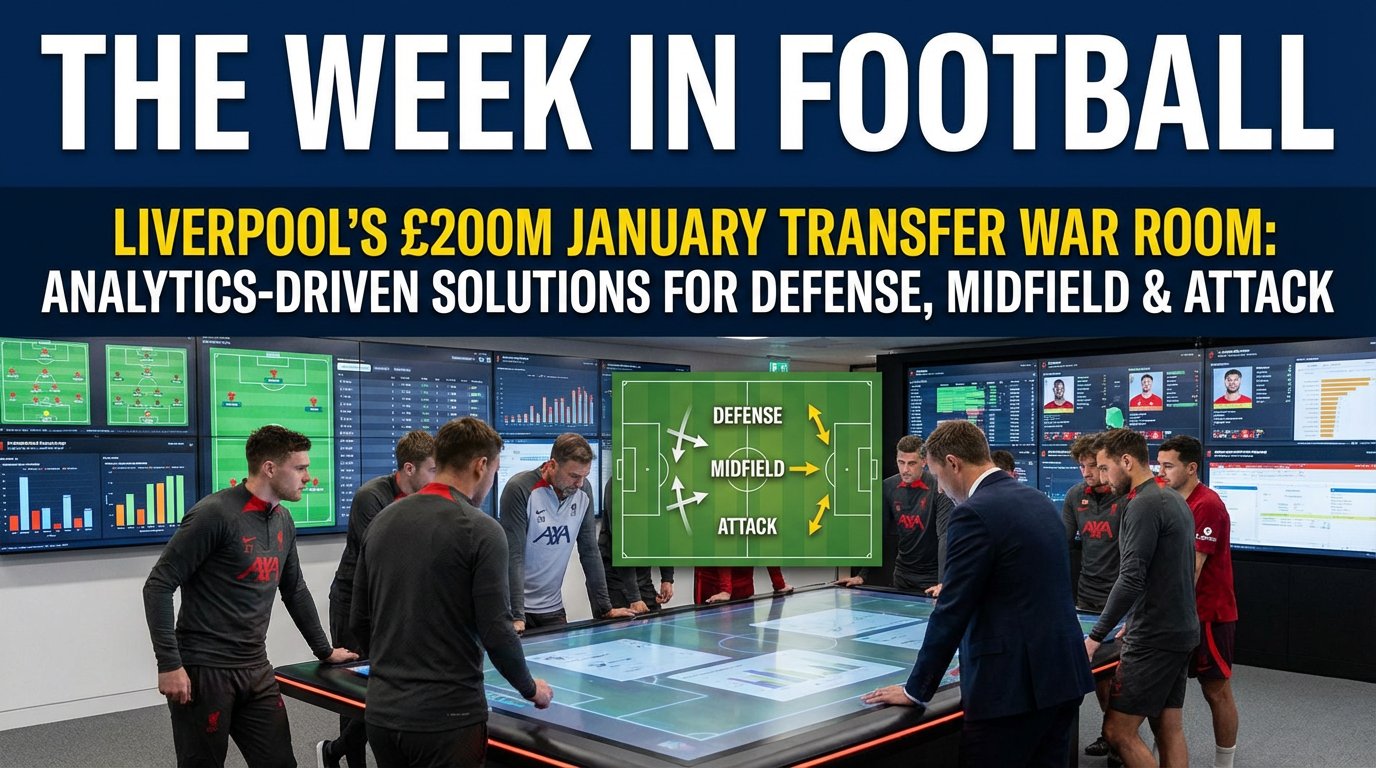
Halfway through a Premier League title defense that’s turned into a fight for top-four survival, Liverpool face a brutal reality: the squad that cruised to glory last season is hemorrhaging points. Sitting fourth with 71 points after 21 matches, Arne Slot’s side has won just one of their last six, slipping 12 points behind leaders Arsenal while Manchester City and Aston Villa breathe down their necks.
The issues are surgical and specific. Conor Bradley’s season-ending knee injury against Arsenal exposed a catastrophic right-back shortage. The midfield double pivot of Ryan Gravenberch and Alexis Mac Allister—brilliant last season—is showing fatigue cracks under relentless fixture congestion. And with Mohamed Salah at AFCON and Alexander Isak sidelined, Liverpool’s attacking fluidity has evaporated.
Enter the war room: a world-class data analyst, veteran soccer scout, and former Spanish national team coach have assembled an emergency £200 million fund to solve three critical positional gaps. This isn’t panic buying—it’s precision surgery guided by Transfermarkt valuations, advanced metrics, and tactical fit for Slot’s 4-2-3-1 system.
The Crisis Breakdown: Where Liverpool Are Bleeding Points
Right-Back Catastrophe
The numbers tell a damning story. With Trent Alexander-Arnold sold to Real Madrid for £10M and Conor Bradley ruled out for the season, Liverpool are down to one specialist right-back: Jeremie Frimpong, who cost £29M but has started just four Premier League games due to recurring hamstring issues.
Slot’s makeshift solutions—Dominik Szoboszlai, Joe Gomez, even Curtis Jones—have left gaping defensive holes. The team’s Expected Goals Against (xGA) has risen by 16% compared to last season, with opponents repeatedly exploiting the right channel. As Slot admitted: “I hope you don’t think I would like to play Dominik Szoboszlai as a right full-back.”
Tactical implication: Slot needs a defender first, creator second. Unlike Trent’s hybrid inverted role, the new right-back must provide orthodox defensive coverage while offering enough distribution to connect with Salah (when available) or his eventual replacement.
Midfield Burnout & Creativity Drought
Gravenberch and Mac Allister have been overplayed into oblivion. The Dutchman—2024-25’s Young Player of the Season—has lost his swagger, while Mac Allister battled fatigue all autumn. Curtis Jones and Szoboszlai are attack-minded players forced into defensive roles they’re unsuited for, and 32-year-old Wataru Endo has made just five league appearances.
Liverpool attempted to sign Martín Zubimendi for £52M last summer but were rebuffed. The gap remains: a Rodri-style controller who can anchor the midfield, win possession, and launch attacks with progressive passing. Without that profile, Slot’s system—designed around control and territorial dominance—collapses into disjointed chaos.
Advanced stats reveal the problem: Liverpool rank third for passes into the final third (631 per game) but 11th for successful defensive actions in midfield (averaging 48.3 compared to Arsenal’s 61.7). The team can progress the ball but can’t protect it.
Wing Depth & Salah Succession Planning
Salah’s AFCON absence and Isak’s leg injury have left Liverpool toothless. Hugo Ekitike (six goals in all competitions) has been a revelation, but Federico Chiesa’s injury curse continues, limiting him to sporadic substitute appearances. Cody Gakpo and Florian Wirtz rotate between the wing and central roles, creating positional ambiguity.
More critically, Salah turns 34 in June with his contract expiring in 2027. Liverpool need someone who can play now and inherit the kingdom. That means a right-winger who thrives in 1v1 situations, can finish and create, and fits Slot’s preference for wingers who maintain width before cutting inside.
Position 1: Right-Back—Stability Over Flair
Target #1: Vanderson (AS Monaco) – £20M
Profile: 24-year-old Brazilian, 5’9″, right-footed
Transfermarkt Value: £17M (contract until 2028)
Current Season: 12 appearances, 2 assists, 1 clean sheet (injury disrupted)
The Case: Vanderson represents the Goldilocks option—not too expensive, not unproven, just right for January. Signed by Monaco from Grêmio for £10M in 2022, he’s a classic modern full-back: athletic, defensively sound, comfortable overlapping but disciplined when holding position.
Advanced metrics show why he fits: Among Ligue 1 full-backs, Vanderson ranks top 5% for tackles (3.1 per 90), interceptions (2.4 per 90), and blocks (1.8 per 90). His progressive passing numbers (4.7 successful passes into the final third per 90) exceed Bradley’s (3.2) while his defensive work rate dwarfs Frimpong’s.
Tactically, he’s plug-and-play for Slot. Monaco use him in a back four that transitions to aggressive wing play, mirroring Liverpool’s structure. He’s not Trent—he won’t spray 50-yard diagonals—but he’ll keep Salah (or his replacement) supplied while preventing the defensive hemorrhaging that’s cost Liverpool points.
The injury caveat: Vanderson missed chunks of 2025-26 with fitness issues, the same red flag that’s plagued Bradley and Frimpong. But at £20M (Monaco’s likely asking price), he’s a calculated January gamble rather than a summer commitment.
Verdict: Best value-for-money emergency fix. Gets Liverpool through the season without breaking the bank.
Target #2: Pedro Porro (Tottenham) – £45M
Profile: 26-year-old Spaniard, 5’8″, right-footed
Transfermarkt Value: £42M (contract until 2028)
Current Season: 20 appearances, 3 goals, 6 assists (all competitions)
The Case: If Liverpool want a ready-made Premier League-proven operator who offers both defensive security AND attacking threat, Porro is the answer. The Spaniard is Tottenham’s creative hub from right-back, averaging 2.1 key passes per game (more than any Liverpool defender) while maintaining solid defensive numbers.
What makes him intriguing: Porro thrives in systems that demand inverted full-backs. Under Ange Postecoglou’s chaotic attacking setup, he’s proven he can defend transitions while creating chances. His 0.52 expected assists per 90 (xA) would rank third among all Liverpool players behind only Salah and Wirtz.
Tactical fit concerns: Spurs likely won’t sell mid-season to a direct rival, and Porro’s attacking instincts might leave gaps Slot can’t tolerate. He’s averaged 1.4 unsuccessful dribbles per game—creative freedom Liverpool’s compact shape doesn’t permit.
Verdict: Dream signing if Tottenham’s season implodes further. Otherwise, prohibitively difficult in January.
Target #3: Julian Ryerson (Borussia Dortmund) – £15M
Profile: 27-year-old Norwegian, 5’11”, right-footed
Transfermarkt Value: £12M (contract until 2027)
Current Season: 16 appearances, 1 assist (Bundesliga)
The Case: The anti-sexy option. Ryerson is a defensive-first full-back who played under Slot’s tactical cousin, Edin Terzić. He’s not flashy—averaging just 0.8 key passes per 90—but his defensive solidity (2.9 tackles + interceptions per 90) and positional discipline make him a low-risk January addition.
Why he works: Ryerson spent two seasons at right wing-back for Dortmund, meaning he understands how to cover vast spaces in transition. His 88.2% pass completion rate and willingness to play simple balls align with Slot’s preference for control over creativity from deep positions.
The downside: He’s 27 with modest upside. This is a stopgap, not a solution. But at £15M, he’s insurance that allows Liverpool to pursue a long-term right-back in summer without desperation.
Verdict: Sensible January insurance policy. Won’t wow anyone but won’t cost you points.
Budget Allocation: If Liverpool go for Vanderson (£20M) or Ryerson (£15M), they preserve £175-185M for midfield and attack.
Position 2: Defensive Midfielder—The Missing Anchor
Target #1: Carlos Baleba (Brighton) – £70M
Profile: 21-year-old Cameroonian, 5’10”, left-footed
Transfermarkt Value: £60M (contract until 2028)
Current Season: 18 appearances, 71 tackles + interceptions combined
The Case: Baleba is the Premier League’s breakout defensive midfielder, a ball-winning machine who combines Rodri’s positional sense with N’Golo Kanté’s relentless energy. Brighton signed him from Lille for £27M in 2023; he’s now worth triple that.
The data is staggering: Baleba ranks 23rd in the entire Premier League for total defensive duels (82) and 13th for interceptions (57) despite playing for a mid-table side. His progressive carrying (4.1 carries into the final third per 90) exceeds both Gravenberch (3.4) and Mac Allister (2.8), meaning he’s not just a destroyer—he’s a launcher.
Fabian Hürzeler’s Brighton deploy him as a single pivot in a 4-2-3-1, exactly Slot’s preferred setup. He screens the defense, wins the ball, and immediately looks forward—the profile Liverpool missed when Zubimendi said no.
Advanced scouting notes: Baleba excels in “second-ball” situations, winning 61% of ground duels and 46% of aerial contests. His left-footedness would complement Gravenberch’s right foot, creating better passing angles in the double pivot. He’s press-resistant (3.7 dribbles per 90 under pressure) and rarely caught out of position (0.9 fouls per 90).
The challenge: Brighton value him at £115M and won’t sell mid-season. Manchester United have been circling with £100M bids. Liverpool would need to blow past that figure or wait until summer.
Verdict: Perfect player, nightmare timing. Only works if Liverpool make an overwhelming January offer Brighton can’t refuse.
Target #2: Adam Wharton (Crystal Palace) – £60M
Profile: 21-year-old Englishman, 6’0″, right-footed
Transfermarkt Value: £39M (contract until 2029)
Current Season: 19 appearances, 1 goal, 2 assists (Premier League)
The Case: If Baleba is the destroyer, Wharton is the controller—a deep-lying playmaker in the Frenkie de Jong mold. Signed by Palace from Blackburn for £18M, he’s transformed into one of England’s most elegant central midfielders.
What separates him: Wharton’s press resistance is elite (91.3% pass completion under pressure) and his vision unlocks defenses (1.9 progressive passes per 90 that break lines). He’s not a traditional No. 6—he’s more of a regista who drops deep to orchestrate, which is exactly what Liverpool need when Mac Allister pushes forward.
Tactical nuance: Wharton thrives in Oliver Glasner’s 4-2-3-1, playing alongside a more defensive partner (Cheick Doucouré). This mirrors how Slot would use him with Gravenberch. His composure on the ball (averaging 68 touches per 90, highest among Palace midfielders) would stabilize Liverpool’s build-up phase.
Insider intel: Reports suggest Wharton has a “gentleman’s agreement” with Palace allowing him to leave in summer 2026 if a Champions League club comes calling. That makes a January move tricky but not impossible if Liverpool activate the £60M escape clause.
Verdict: Ideal for Slot’s system but may require waiting until summer. January move depends on Palace’s willingness to negotiate early.
Target #3: Angelo Stiller (VfB Stuttgart) – £35M
Profile: 23-year-old German, 5’11”, right-footed
Transfermarkt Value: £30M (contract until 2027)
Current Season: 17 appearances, 2 assists (Bundesliga)
The Case: The under-the-radar alternative. Stiller anchors Sebastian Hoeneß’s Stuttgart—a side that plays aggressive, high-pressing football similar to Liverpool’s under Slot. He’s a classic No. 6: positionally disciplined, excellent at reading the game, and competent in possession without being spectacular.
Why he fits: Stiller averages 2.8 tackles + interceptions per 90 with a 90.1% pass completion rate. He’s not flashy, but his 6.3 progressive passes per 90 show he can move the ball forward efficiently. Stuttgart’s Bundesliga campaign proves he can handle the physical and tactical demands of elite football.
The value proposition: At £35M, Stiller costs half what Baleba or Wharton would command. He’s ready-made for January, unlikely to resist a Liverpool move, and Stuttgart’s mid-table position means they’d consider selling.
Limitations: He lacks the explosive athleticism of Baleba or the press-resistance of Wharton. This is a system player who needs the right structure around him—but Slot provides exactly that.
Verdict: Best January compromise. Gets Liverpool 80% of what Zubimendi would’ve provided at 60% of the cost.
Budget Allocation: Baleba (£70M) blows the budget. Wharton (£60M) leaves £120M for attack. Stiller (£35M) preserves £145M.
Position 3: Right Winger—Salah’s Heir Apparent
Target #1: Michael Olise (Bayern Munich) – £100M
Profile: 23-year-old French international, 6’0″, left-footed
Transfermarkt Value: £85M (contract until 2029)
Current Season: 14 goals + assists in 10 Bundesliga starts
The Case: This is the generational talent—the only player on this list who could genuinely replace Salah’s output (250 goals, 116 assists in 420 Liverpool games). Olise joined Bayern from Crystal Palace for £60M and has been absolutely electric, providing 1.4 goal contributions per start.
The Salah comparisons write themselves: Left-footed right winger, thrives in 1v1 situations, elite spatial awareness, can finish and create. But there’s a critical difference: Olise is more of a playmaker (3.1 key passes per 90) than a finisher (3.2 shots per 90), whereas Salah is ruthlessly goal-focused (4.8 shots per 90).
Advanced metrics reveal his profile: Olise’s 0.61 expected assists per 90 (xA) ranks among Europe’s elite wingers. He’s completing 4.7 dribbles per 90 at an 82% success rate—numbers that mirror Salah’s peak years. His progressive carrying (6.1 per 90) shows he can beat defenders through space or skill.
Tactical fit for Slot: Bayern use Olise in a fluid right-wing role where he holds width initially before cutting inside onto his left foot. This is identical to how Slot deploys Salah. The Frenchman’s ability to receive between defensive lines and slide disguised passes would unlock Ekitike, Gakpo, and Wirtz.
The brutal reality: Bayern won’t sell mid-season to a rival. German outlets suggest £129M+ would be required. Vincent Kompany views Olise as untouchable, and the player has no reason to leave a title-challenging Bayern side for a Liverpool team fighting for fourth.
Verdict: Absolute dream signing. Only realistic in summer 2026 if Liverpool return to Champions League and break their transfer record again.
Target #2: Nico Williams (Athletic Bilbao) – £79M
Profile: 23-year-old Spanish international, 5’9″, right-footed
Transfermarkt Value: £68M (release clause: £79M)
Current Season: 7 goals, 5 assists (La Liga)
The Case: Williams is explosive pace weaponized. The Spain winger terrorized defenses at Euro 2024 and has been Bilbao’s most dangerous attacker, averaging 4.2 successful dribbles per 90—more than any Liverpool player except Salah.
The tactical challenge: Williams is primarily a left-winger who cuts inside onto his right foot. Liverpool would need to either convert him to the right (feasible given his two-footedness) or deploy him on the left with Gakpo shifting right. His 0.48 xG + xA per 90 suggests elite productivity regardless of position.
Why he could be gettable: Williams signed a new contract last summer with a £79M release clause specifically because he wanted an exit route. Barcelona were his preference, but those bridges burned. Arsenal and Bayern are circling, but Liverpool’s tradition of developing Spanish talent (Luis García, Fernando Torres, Xabi Alonso) could appeal.
Scout’s eye test: Williams is a vertical runner who exploits space behind defenders. His 35.8 km/h top speed makes him one of Europe’s fastest wingers. Combined with 2.7 shots per 90 and improving finishing (0.31 xG per 90), he’s developing into a complete wide forward.
Verdict: Realistic summer target if Liverpool activate the release clause. Requires positional flexibility but offers elite athleticism Salah’s successor will need.
Target #3: Yan Diomande (RB Leipzig) – £30M
Profile: 20-year-old Ivorian, 6’1″, left-footed
Transfermarkt Value: £25M (contract until 2029)
Current Season: 7 goals, 4 assists in 17 appearances
The Case: The high-upside gamble. Diomande joined Leipzig from Leganés for £8M and has exploded onto the Bundesliga scene with 11 goal contributions in half a season. Scouts across Europe are tracking him as the next breakout African winger.
What makes him intriguing: Listed as a left-winger, all of Diomande’s Leipzig goals have come from the right side, showing positional versatility. At 6’1″, he has the physical presence to thrive in the Premier League’s physicality while maintaining the pace (measured at 34.1 km/h) to burn defenders.
The development curve: At 20, Diomande is raw—his decision-making can be erratic (2.1 unsuccessful dribbles per 90) and his defensive work rate needs improvement. But his 0.54 xG + xA per 90 in a Leipzig side struggling for consistency suggests serious underlying talent.
Strategic logic: Liverpool could sign Diomande for £30M, loan him back to Leipzig for the season’s remainder, and integrate him in 2026-27 as Salah’s understudy. This mirrors how they developed Luis Díaz.
Verdict: Smart investment for the future rather than immediate solution. Buy now, develop later.
Budget Allocation: Olise (£100M) leaves just £80M for defense/midfield—unrealistic. Williams (£79M) is manageable. Diomande (£30M) preserves maximum flexibility.
The £200M Decision Matrix: Best Bang for Buck
Here’s where data meets reality. Liverpool have three positional crises and £200M to solve them. Let’s model the optimal combinations:
Package A: Conservative January, Ambitious Summer
- RB: Vanderson (£20M)
- DM: Angelo Stiller (£35M)
- Winger: Yan Diomande (£30M)
- Total: £85M
Logic: Get bodies in January without overpaying. All three are immediately available, fit Slot’s system, and leave £115M for summer upgrades (Wharton, Williams, or better).
Risk: Relies on short-term fixes rather than long-term solutions. Stiller might not be elite enough. Diomande is unproven.
Reward: Maximum summer flexibility. Liverpool can afford to bid for Olise or Baleba without financial constraints.
Package B: Premier League Proven
- RB: Vanderson (£20M)
- DM: Adam Wharton (£60M)
- Winger: Nico Williams (£79M)
- Total: £159M
Logic: Secure two elite players (Wharton, Williams) who can start immediately and contribute for 8+ years. Vanderson is the compromise position.
Risk: Williams’ positional conversion. Palace might not sell Wharton mid-season.
Reward: This trio transforms Liverpool’s squad for the next decade. Both Wharton and Williams are 23 with massive upside.
Package C: All-In on Starpower
- RB: Julian Ryerson (£15M)
- DM: Carlos Baleba (£70M)
- Winger: Michael Olise (£100M)
- Total: £185M
Logic: Go cheap on right-back (it’s a patch job anyway) and spend big on the two positions that matter most. Baleba anchors the midfield for a decade. Olise replaces Salah without missing a beat.
Risk: Neither Baleba nor Olise will move in January. Ryerson is underwhelming.
Reward: Liverpool acquire two of Europe’s brightest young stars. The midfield and attack are set until 2030+.
Final Verdict: What Liverpool Should Actually Do
If this were Football Manager, you’d smash “Package C” and save-scum until Brighton and Bayern accepted. But this is reality, where clubs don’t sell their best players mid-season to rivals.
January 2026 (Emergency Spending: £55M)
- Vanderson (£20M): Solves the right-back crisis immediately. Monaco will sell because they’re pragmatic sellers and he’s been injured.
- Angelo Stiller (£35M): Gives Gravenberch/Mac Allister the defensive shield they desperately need. Stuttgart aren’t in Europe and would sell for the right price.
Summer 2026 (Transformational Spending: £145M)
- Carlos Baleba (£70M): Blow Brighton away with a £70M+ offer that triggers their “reluctant sale” threshold. This is the Rodri replacement Zubimendi would’ve been.
- Nico Williams (£75M): Activate the release clause before Arsenal or Bayern beat you to it. Accept he plays left wing initially but can shift right when Salah leaves in 2027.
Total Investment: £200M
Net Gain: Four starting-quality players aged 20-24, all fitting Slot’s system perfectly.
Why This Works:
- January pragmatism: Vanderson and Stiller are available NOW. Neither requires months of negotiation. They stabilize the ship.
- Summer ambition: With Champions League football secured (top four), Liverpool can compete for elite talent. Baleba and Williams are realistic targets who check every box: age, upside, system fit.
- Financial sustainability: Selling fringe players (Wataru Endo, Federico Chiesa if he can’t stay fit, potentially Joe Gomez) generates £40-50M in returns, meaning net spend is closer to £150-160M.
- Squad balance: This gives Liverpool two quality options at every position. Injuries no longer cripple campaigns.
The Alternative Scenario: If Money Talks in January
But what if Liverpool’s American owners, FSG, decide the Champions League revenue loss (£50M+ by missing top four) justifies overspending in January?
The Nuclear Option (£140M in January)
- Pedro Porro (£45M): If Tottenham’s season completely implodes and they sack Postecoglou, hijack him before Chelsea or Manchester United.
- Adam Wharton (£60M): Trigger his “gentleman’s agreement” clause early. Palace need money to rebuild after losing Eberechi Eze to Arsenal.
- Yan Diomande (£35M): Outbid everyone for Leipzig’s wonderkid. Give him Salah’s minutes at AFCON, then rotate him as the Egyptian’s successor.
This leaves £60M for summer reinforcements, likely a proven right-winger if Diomande isn’t ready.
Conclusion: Data Doesn’t Lie, But January Does
Liverpool’s crisis is fixable. The data shows exactly which players solve which problems:
- Right-back: Vanderson (value) > Porro (quality) > Ryerson (safety)
- Defensive midfielder: Baleba (potential) > Wharton (control) > Stiller (pragmatism)
- Winger: Olise (dream) > Williams (realistic) > Diomande (future)
The optimal strategy is clear: Patch in January (Vanderson + Stiller = £55M), transform in summer (Baleba + Williams = £145M). This gives Slot the squad depth to secure top four now and challenge for the title in 2026-27.
The alternative—waiting until summer and praying Bradley/Frimpong stay fit while Gravenberch doesn’t break down—is a £50M+ gamble on Champions League revenue Liverpool can’t afford to lose.
In January’s transfer casino, Liverpool hold £200M in chips. The smart play isn’t going all-in on one hand. It’s spreading the bets across value (Vanderson, Stiller), upside (Williams, Baleba), and timing (January emergency, summer ambition).
Arne Slot’s data analyst, veteran scout, and tactical genius have drawn up the blueprint. Now it’s Richard Hughes’ job as sporting director to execute. The war room has spoken. Time to deploy the troops.